Parking garage repair and restoration - RTC Restoration & Glass Dallas-Fort Worth, Austin, Houston, Oklahoma, Louisiana

Parking Garage Repair and Restoration

RTC offers a wide variety of parking garage repair and restoration services

RTC Restoration & Glass specializes in parking garage restoration, structural repair, concrete repair, waterproofing, and ongoing maintenance for existing parking structures.

Parking garages face some of the harshest conditions of any part of a building. They are constantly exposed to vehicle traffic, water intrusion, temperature changes, chemicals, road salts, and other environmental factors. Because of this exposure, parking garages typically require more frequent inspection, maintenance, and repair than many building façades.

If deterioration goes unaddressed, relatively minor problems can become significant structural concerns. Cracked and spalled concrete, exposed or corroding reinforcing steel, failed expansion joints, deteriorated traffic coatings, and water intrusion can accelerate deterioration of the parking structure. If these conditions progress, structural deterioration can eventually create serious life-safety concerns and substantially increase repair costs.

RTC performs parking garage repair and restoration for commercial buildings, hotels, condominiums, luxury apartments, and other existing properties throughout Dallas, Austin, Houston, and the surrounding Texas markets.

Our parking garage services include structural concrete repair, concrete restoration, crack repair, spall repair, waterproofing, traffic-bearing coatings, expansion joint repair, sealants, drainage-related repairs, structural repairs, and preventive maintenance. Early repairs and a planned maintenance program can extend a parking garage’s service life, reduce long-term repair costs, and help keep the structure safe.

Parking Garage Restoration

RTC handles complex parking garage restoration projects designed to restore structural integrity, safety, functionality, and appearance. Work may include structural concrete repair to address damaged or deteriorated areas and supplemental steel reinforcement to strengthen structural components.

Exterior restoration can involve removing existing brick or CMU and installing thin-set brick on new stud walls. RTC also performs parking deck repair or replacement when deterioration requires more extensive rehabilitation.

To improve vehicle and pedestrian safety, new vehicle retention cables can be installed throughout designated areas. Together, these services provide a comprehensive approach to extending the useful life of parking structures.

Parking garage repair and restoration - RTC Restoration & Glass Dallas-Fort Worth, Austin, Houston, Oklahoma, Louisiana
Repair after moving truck hit precast double-tee
Parking garage repair and restoration - RTC Restoration & Glass Dallas-Fort Worth, Austin, Houston, Oklahoma, Louisiana

Extensive Double-Tee Repair

With Extensive Double-Tee Parking Garage Repair, the deterioration is substantial enough that simple crack sealing or small concrete patches aren’t sufficient. 

This type of repair may involve the removal of deteriorated or delaminated concrete, exposing and cleaning corroded reinforcing steel, replacing or supplementing damaged reinforcement, treating corrosion, rebuilding the concrete section with repair materials, repairing flange-to-flange connections, and addressing damaged stems, ends, bearing areas, or prestressing-related components where appropriate.

Expansion Joints & Control Joints

Expansion joints and control joints are critical components of a parking garage deck. Although they serve different purposes, failure of either can lead to water intrusion, concrete deterioration, and structural damage.

Expansion Joint Installation and Repair
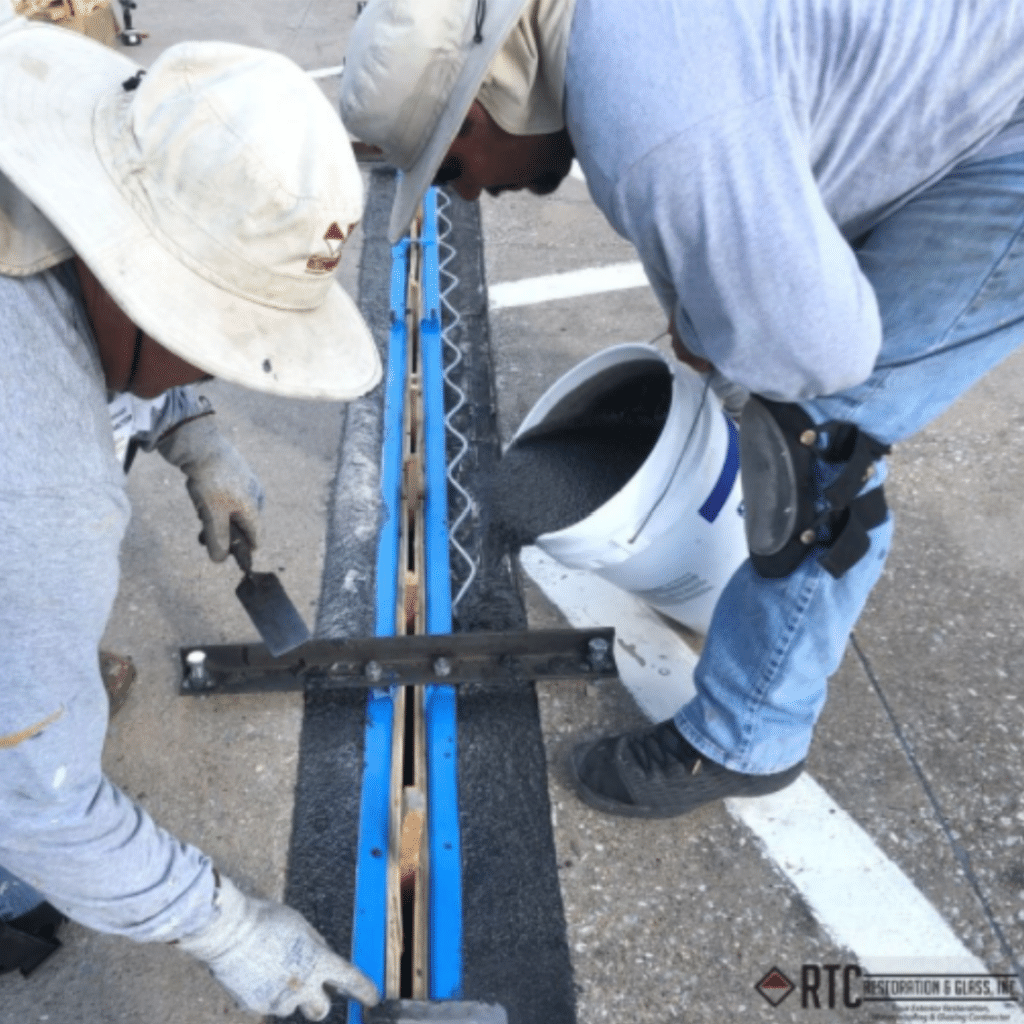
Most parking garages have expansion joints to accommodate the structure’s expansion and contraction caused by seasonal temperature changes. These joints are typically 6 inches or more wide depending on the expansion joint system and structural design. As temperatures increase, the parking deck expands and the expansion joints close. During colder weather, the deck contracts and the joints open. A properly designed expansion joint system must have this continuous cyclic movement while maintaining a watertight seal. Because parking garage expansion joints are subjected to vehicular traffic and constant structural movement, they wear significantly. Ongoing inspection, maintenance, repair, and eventual replacement are necessary to prevent water intrusion and deterioration of the surrounding concrete.

Control Joints & Double Tee Connections
Control joints are typically located directly over the seam where adjacent precast Double Tees connect and are commonly 1⁄2 inch wide.
A frequent problem in precast parking garages occurs when the shear connections between Double Tees deteriorate or fail. Movement between the Double Tees can then cause the control joint sealant to fail. One noticeable indication of a deteriorated Double Tee connection is a loud thump when vehicles cross the joint. This can indicate excessive movement between adjacent Double Tees and should be investigated. If deteriorated connections are not repaired in a timely manner, continued movement and impact loading can contribute to cracking and spalling of the Double Tee stems and surrounding concrete, potentially resulting in more extensive and costly structural repairs.

Expansion Joint Installation & Control Joint Installation

Resurfacing - Deck Coating

Resurfacing and deck coating restore and protect concrete surfaces from environmental deterioration, traffic wear, chemicals, and water damage.

The process begins with surface preparation and structural crack repairs using epoxy pressure injection to address cracks that affect concrete integrity.

Top deck crack grouting and sealing prevent moisture and contaminants from penetrating the concrete. 

Finally, applying vehicular traffic coating to the entire top deck creates a durable, protective, water-resistant wearing surface designed to withstand vehicle traffic and extend the parking structure’s life.

Cracked Concrete Repair

Cracked concrete repair for an underground parking garage begins by identifying and preparing damaged areas. RTC Technicians clean, route, and repair cracks using appropriate epoxy injection, grout, or sealant systems.

Deteriorated or loose concrete is removed and patched as needed. These cracked concrete repairs help restore concrete integrity, limit water intrusion, protect reinforcing steel from corrosion, and extend the parking garage’s service life.

FAQ

A detailed answer to provide information about your business, build trust with potential clients, and help convince the visitor that you are a good fit for them.

Overhead Concrete Patching

Overhead concrete repair in a parking garage addresses deteriorated concrete on the undersides of elevated decks, beams, and other structural components.

Repairs typically begin by removing loose, cracked, or delaminated concrete and exposing damaged reinforcing steel. The steel is cleaned, treated for corrosion, and repaired or supplemented when necessary.

Crews then rebuild affected areas using structural repair mortar or concrete designed for overhead applications. Cracks and sources of water intrusion may also be repaired to prevent future deterioration. When necessary, temporary shoring and protective measures are installed.

These repairs improve safety, restore structural integrity, protect reinforcement, and extend the garage’s service life.